{{account.name}}

Citizens @ Home

Building vs. Buying a Home

Consider the advantages of building vs. buying a home

When you're in the market for a new home, you may be considering whether or not to buy or build a house. While the housing market offers a wide inventory of styles, price ranges, and locations, buying may not suit everyone's needs or desires. Building a home, on the other hand, allows homeowners to customize the property to their unique specifications, creating a place that's perfectly suited to the habits, lifestyle, and tastes of their families.

Relative costs of buying or building a house

There are different costs associated with buying and building a house. Buying a home may mean you initially sacrifice some of the features you want, possibly choosing to make renovations later. It also means you are subject to the market. When there are more existing homes on the market than there are sellers available to buy them, prices can be more attractive. However, in a seller's market, you may face a markup you wouldn't otherwise see. Consider the following costs associated with buying a new home:

  • The initial purchase price of the home and land
  • The time it takes to find a home, negotiate an offer, and close
  • Any home renovations you need to make to adapt the home to your family's use
  • Closing costs and legal fees
  • A real estate agent's commission

Building can also be costly and time-consuming. While it offers a perfectly customized home in the end, it can often take longer than you might expect to go from architectural renderings to move-in date. When builders and contractors are busy with many new building projects, it can be difficult and expensive to obtain their services for your new dream house. When they hit slow seasons, just like in any other industry, they're more amenable to making price concessions. Consider the following costs for building a new home:

  • The initial cost of the land if you're not building on land you already own
  • Cost of materials and design services
  • Contractor fees
  • The time it takes to build the home
Important considerations when debating building vs. buying a home

It's important to consider the state of supply and demand at any particular time. There are so many tasks to complete - from buying the lot, securing building permits, hiring a contractor and seeing to utility hook-ups, as well as getting construction financing in place. And don't forget those choices about various styles of home floor plans.

After considering all those requisite steps, the idea of buying a pre-existing house might begin looking a little easier. However, don't forget that buying a home comes with its own considerations. You'll still need to decide from among the different types of homes to buy and then find a home that meets the majority of your qualifications.

You might begin thinking of the hybrid strategy of buying a fixer-upper. This option allows you to start with a structure in place that you can renovate as much as you want to fit your tastes. This will also be costly, but having the house constructed will save some time.

Checklist for hiring a contractor when buying or building a house

When hiring a contractor to build a home or renovate your new fixer-upper, it's important to obtain several quotes and investigate each contractor's work before making a final decision:

  • Check with the Better Business Bureau to see if the contractor has accumulated complaints.
  • Make sure the company has sufficient workers compensation and general liability coverage. Otherwise, you could be stuck with the bill for any accident.
  • Check for quality workmanship in the contractor's current and past work.
  • Be wary of unexpectedly low bids, which might not cover costs that are certain to develop later.
  • Make sure the company has a permanent address and a good reputation with lenders and vendors.
  • Ask friends, family or co-workers for personal recommendations.
  • Make sure you receive a clearly written contract for the work.
Be informed and consider all the options of building vs. buying a home

Consider the costs of buying or building a house to decide which option might be right for you. Whatever you decide, Citizens can help you with financing.

Contact me today and let’s have a conversation about which mortgage option meets your financing goal.

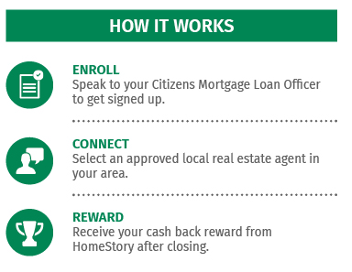
Your Home Rewards from Citizens

Looking to Buy or Sell a home? Earn cash back rewards ($350-$9,500)1 with Your Home Rewards from Citizens.

Connect with top performing agents in your local market and you could earn from $350 to $9,500 after close. With Your Home Rewards from Citizens, offered in partnership with HomeStory Real Estate Services, we’ll help you choose a local, certified real estate agent with over a 90% customer satisfaction rating who’ll help you close up to 42% faster.

Our top‐rated real estate agents come with:

  • Two or more years of full‐time real estate experience
  • Minimum of 15 closed transactions within the last 24 months
  • Maintain over 90%+ customer satisfaction
  • Active membership in good standing with local MLS and state board

To get started, simply speak to me about signing up for your Home Rewards from Citizens and get on the fast track to earning your cash back reward.

1Your Home Rewards from Citizens™ is offered in partnership with HomeStory Real Estate Services, a licensed real estate broker. HomeStory Real Estate Services is not affiliated with Citizens Bank, N.A., and Citizens Bank, N.A. is not responsible for the program provided by HomeStory Real Estate Services. Qualifying for the reward requires using a real estate agent that participates in HomeStory’s broker‐to‐ broker agreement to complete the real estate buy and/or sell transaction. You retain the right to negotiate buyer and/or seller representation agreements. Upon successful close of the transaction, the real estate agent pays a referral fee to HomeStory Real Estate Services. All agents have been independently vetted by HomeStory to meet performance expectations required to participate in the program. If you are currently working with a REALTOR®, please disregard this notice. It is not our intention to solicit the offerings of other REALTORS®. A reward is not available where prohibited by state law, including Alaska, Iowa, Louisiana and Missouri. A reduced agent commission may be available for sellers in lieu of the reward in Mississippi, New Jersey, Oklahoma and Oregon, and should be discussed with the agent upon enrollment. No reward will be available for buyers in Mississippi, Oklahoma, and Oregon. A commission credit may be available for buyers in lieu of the reward in New Jersey and must be discussed with the agent upon enrollment and included in a Buyer Agency Agreement with Rebate Provision. Rewards in Kansas and Tennessee are required to be delivered by gift card.

HomeStory will issue the reward using the payment option you select and will be sent to the client enrolled in the program within 45 days of HomeStory Real Estate Services receipt of settlement statements and any other documentation reasonably required to calculate the applicable reward amount. Real estate agent fees and commissions still apply. Short sale transactions do not qualify for the reward. Depending on state regulations highlighted above, the reward amount is based on sale price of the home purchased and/or sold and cannot exceed $9,500 per buy or sell transaction. Employer‐ sponsored relocations may preclude participation in the reward program offering. Citizens Bank, N.A. is not responsible for the reward. The reward is valid for 18 months from the date of enrollment. After 18 months, you must re‐enroll to be eligible for a reward. Offer subject to change or cancellation without notice.

REWARD RESTRICTIONS
A reward is not available in Alaska, Iowa, Louisiana and Missouri. A reduced agent commission may be available for sellers in lieu of the reward in Mississippi, New Jersey, Oklahoma and Oregon, and should be discussed with the agent upon enrollment. No reward will be available for buyers in Mississippi, Oklahoma and Oregon. A commission credit may be available for buyers in lieu of the reward in New Jersey and must be discussed with the agent upon enrollment and included in a Buyer Agency Agreement with Rebate Provision. Rewards in Kansas and Tennessee are required to be delivered by gift card. Kansas is restricted to a flat reward amount not based sales price.

Citizens Bank, N.A. does not perform any activity that is or could be construed as unlicensed real estate activity, and Citizens Bank, N.A. is not licensed as a real estate broker. Agents of Citizens Bank, N.A. are not authorized to perform real estate activity.

The trademarks, logos and names of other companies, products and services are the property of their respective owners.

Meet Citizens FastLine®

A faster, smarter, and better way to finance your next project

Citizens FastLine® makes getting a home equity line of credit simple—its streamlined digital experience allows customers to apply in just minutes and close in as few as seven days. This truly modern borrowing experience allows customers to easily tap into their home equity and have the cash to pay for what matters most in as little as two weeks.

A better way to borrow

A Citizens HELOC allows customers to borrow what they need when they need it. Where some lenders require borrowers to receive their funds as a lump sum, a Citizens HELOC is a revolving line of credit that allows you to draw funds whenever you need and only pay interest on what you use.

With interest rates lower than a credit card or a personal loan, a HELOC can help you fund important things in a smart way, including funding a renovation, paying for education, consolidating your high interest debt, or paying for other large purchases.

The Citizens FastLine data-driven approach provides a high-level of confidence as to how much you may qualify for, and the speed at which you can expect to close.

A modern way to fund big goals

Make the most of your home equity. Your equity can be used for many purposes:

  • Home improvements–The #1 use of home equity is to make home improvements.
  • Education–A HELOC can help cover the cost of private school, college, or an advanced degree.
  • Create steady cash flow–Whether you are looking to create an emergency fund or you are changing careers and want to make sure you have the money to cover your expenses, the equity in your home can help create a steady, reliable cash flow.
  • Consolidate high-interest debt–Some types of debt can help you achieve your goals, but high-interest debt can also derail them. When you’re looking for ways to consolidate debt like auto, personal, and business loans, consider using the equity in your home.

If you are about to take on a renovation project or consolidate high-interest debt, a Citizens HELOC may be the right solution for you. Contact me today to learn more and I’ll connect you with one of our home equity specialists.

Mortgages and HELOCs are offered and originated by Citizens Bank‚ N.A. (NMLS ID# 433960). All loans are subject to approval. Member FDIC

Five Home Improvement Projects To Tackle This Spring

Spring is here, and it’s time to tackle the growing list of projects around your home. The changing seasons and weather can seriously impact the timing of a home improvement project. The availability of contractors and the price of materials may fluctuate throughout the year—not to mention, no one wants to dig a hole for your new fence when the ground is frozen solid.

Deciding where to start can be overwhelming, so here are five of the most popular home improvement projects you can take on this spring.

1. Gutters

It’s not the sexiest home improvement project, but gutter maintenance is necessary—especially after a long winter, as gutters can take a beating with all the snow and ice. You want to make sure the pipes aren’t clogged and the downspouts direct the water at least five feet away from the house.

The good news is that this could be a cheap DIY home project. All you’ll need is a ladder, elbow grease, and—depending on how gross your gutters are—a strong stomach. If you opt for a professional cleaning, it typically costs $107-$197. Alternatively, you could invest in a gutter guard system which keeps debris out and water in, so you’ll spend less time on your ladder.

2. Deck/patio

By starting a deck project in early spring, you’ll be done just in time for BBQ season. A deck can be a worthwhile investment that adds resale value to your home. Refurbishing a deck usually entails replacing boards, sanding, refinishing, or painting, which normally costs $725-$2,519.

If your vision includes more than a sprucing up, you’ll likely be looking at rebuilding. Do your research, find a contractor you trust, and you’ll be lounging in the shade in no time!

3. Roof

Once the snow melts, you’ll want to give your roof a visual inspection. No need to get out the ladder; just grab your smartphone and zoom in to get a little closer. If there's visible damage, such as missing shingles, call a professional as soon as possible. By neglecting your roof, you run the risk of what would have been a quick fix turning into a costly inconvenience, such as water damage.

Roof replacements are a great example of a project that improve both the aesthetic and function of the house. For example, a new roof can increase the value of your home by 7%—and the average mid-size roofing project offers close to a 70% return on investment (ROI).

4. Fencing

Spring is a great time to finally get that fence installed. The ground won’t be frozen, so it’s a less tedious process. Fencing is a great way to add definition and personality to your outdoor space. If you’re considering landscaping or gardening for your yard, think about a living fence (a boundary made up of bushes or small trees). Fencing can also add functionality to your property—it’s a great way to keep pets or small children from wandering away.

5. HVAC

The best time to get your heating and air conditioner serviced or installed is when the bitter cold has passed, and before the heat wave begins—spring. If you wait until the summer to install a cooling system, the availability of HVAC professionals is going to be scarce.

If you’re installing air conditioning, now’s the time to weigh your options between a central system, or room units. They differ in cost and functionality, so do your homework to find the best option for your home and your budget.

What to remember

Home improvements and property upgrades can be pricey and Murphy’s law often applies. So, it’s important to have a contingency fund built into your budget before tackling a project. As a homeowner, you may be able to tap into your home’s equity to fund your renovation project. However, depending on your unique situation, you may also consider a credit card. Do your research to make sure you can make the best decision for your financial situation.